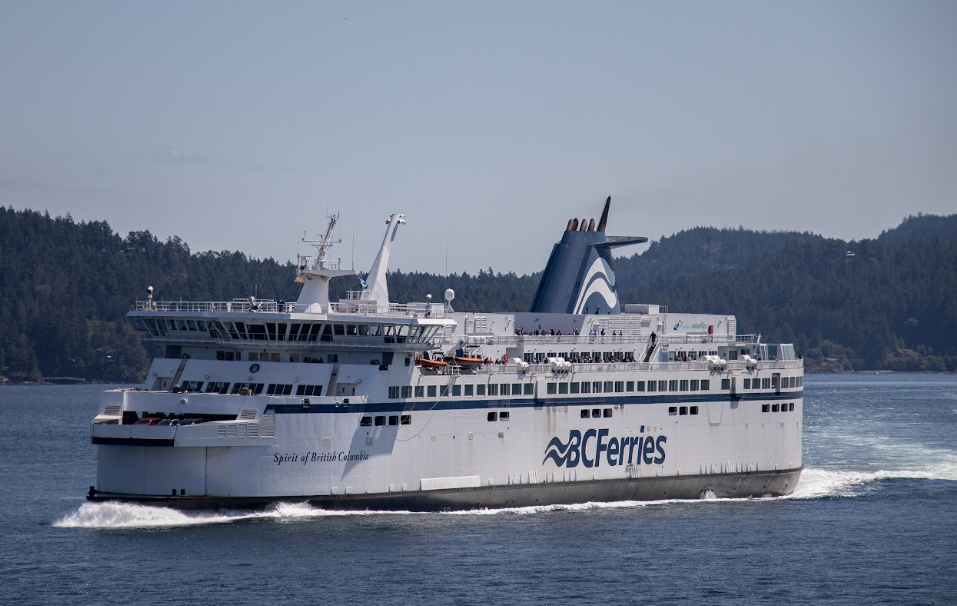
Starting June 1, the company will reduce speeds after one of its ships struck and killed a humpback whale in Wright Sound, just south of Prince Rupert, last year.
Starting June 1, the company will reduce speeds after one of its ships struck and killed a humpback whale in Wright Sound, just south of Prince Rupert, last year.
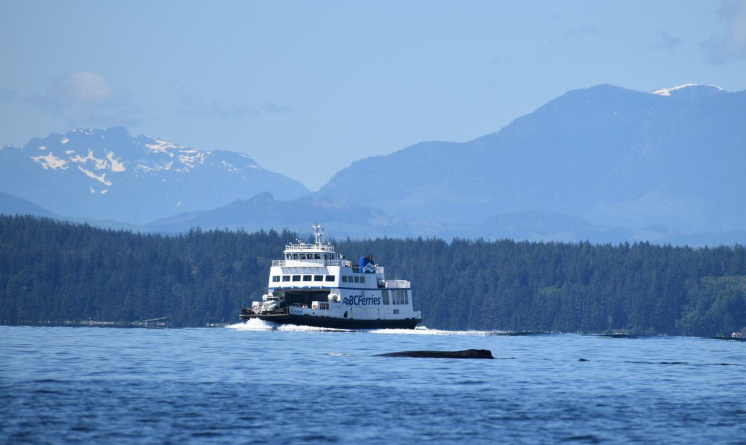
BC Ferries will adjust the schedule of one of its key northern BC routes in an effort to reduce the risk of collisions with humpback whales.
Photo: Cetus Research & Conservation Society
BC Ferries will adjust the schedule of one of its key northern BC routes in an effort to reduce the risk of collisions with humpback whales.
Photo: Cetus Research & Conservation Society
Based on facts either observed and verified firsthand by the reporter, or reported and verified from knowledgeable sources.
Lack of regulations leaves humpback at risk despite BC Ferries slowdown, experts say
Starting June 1, the company will reduce speeds after one of its ships struck and killed a humpback whale in Wright Sound, just south of Prince Rupert, last year.
Get the news and events in Victoria, in your inbox every morning.
Thank you! Your submission has been received!
Oops! Something went wrong while submitting the form.
BC Ferries will adjust the schedule of one of its key northern BC routes in an effort to reduce the risk of collisions with humpback whales.
Photo: Cetus Research & Conservation Society
Researchers welcome a slowdown by BC Ferries through one of the region’s key humpback whale corridors but warn it's not enough without binding federal rules for foreign cruise lines and surging LNG tankers.
Starting June 1, the company will reduce speeds after one of its ships struck and killed a humpback whale in Wright Sound, just south of Prince Rupert, last year.
Emma Shuparski, Straitwatch Quadra coordinator with the Victoria-based Cetus Research & Conservation Society, said studies in Hawaiian waters on humpback whales show that slowing boats to around 10 knots (about 19 kilometres per hour) significantly reduces both the likelihood of hitting a whale and the severity of injuries if a strike occurs.
Even Canadian government measures in the Gulf of St. Lawrence, such as mandatory 10‑knot zones for North Atlantic right whales, are a clear example of how speed reductions are already being used to protect whales.
But it does not eliminate the risk, Shuparski added. "You can kind of liken a speed restriction to a school zone on the road,” she said.
That lingering risk is what concerns researchers studying whale activity along BC’s north coast.
The best morning read in Victoria, bar none.
Stay connected to your city with the Capital Daily newsletter.
By filling out the form above, you agree to receive emails from Capital Daily. You can unsubscribe at any time.
Janie Wray, CEO, founder, and lead researcher with BC Whales, has studied the marine mammals for 20 years at her off-grid Fin Island station in Gitga'at First Nation territory. She hopes the move by BC Ferries will push other operators to follow suit. There are still no federal rules requiring vessels to slow down in whale hotspots, she said.
Wray has seen cruise ships pass dangerously close to humpbacks resting in Gitga’at territory. In one incident, she witnessed a cruise ship speeding through narrow Lewis Pass while a humpback whale slept motionless just off-centre.
"It was fast asleep... and that humpback whale did not move," she said. Had it drifted slightly, "it would have been struck right in that moment."
She said her bigger worry is the sharp increase in LNG tanker traffic past her remote research station. Last year, she said, there were only one or two tankers a week heading toward Kitimat. This year, with LNG Canada now operating out of there and ramping up production, she expects at least one tanker a day, and possibly more, through Wright Sound and nearby channels.
Wray said her team and Gitga'at First Nation have asked LNG Canada to avoid night transits, but those requests have not been answered.
Daytime passages would give researchers a better chance to watch how whales react, both through underwater acoustic monitoring and by observing their behavior from shore. That, she said, could help build a clearer picture of where the risks are and how to reduce them. The Gitga’at Nation told Canada’s National Observer it is still reviewing BC Ferries’ slowdown commitment and isn’t ready to comment yet.
Wray said northern BC waters have transformed dramatically, shifting from sparse whale sightings two decades ago to dense concentrations today, where blows dot the horizon on peak days.
Her team regularly sees groups of eight to 14 humpbacks bubble-net feeding in busy shipping lanes. Drone photos now show more scars from ship propellers and marks from fishing ropes wrapped around whales that survived. Some familiar whales have disappeared, likely killed in crashes that ships never notice or report, she added.
Wray has seen the consequences firsthand—her team recovered Midnight’s body
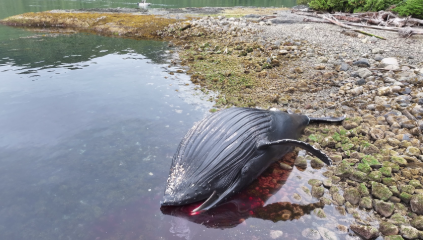
On Sept. 17, 2025, a humpback whale known as “Midnight” was killed in a collision with a BC Ferries vessel in Gitga’at territory. The body was secured by researchers from BC Whales and Gitga’at Oceans and Lands so a necropsy could be carried out to determine the cause of death.
“It was pretty traumatic,” said Wray, who had tracked Midnight for years.
Midnight, found dead. Photo: Janie Wray / BC Whales
She said the Gitga'at First Nation had already reached out to BC Ferries, noting that Wright Sound, about 135 km south of Prince Rupert, is a prime hot spot for humpback and fin whales. During peak season, the waters fill with whales, with blows visible across the horizon. Many move just below the surface, invisible to vessels until they suddenly surface.
Northern BC waters have seen repeated humpback-vessel collisions, including three fatal strikes during a single 10-day period in 2023 near Prince Rupert, Kitimat, and Haida Gwaii.
Lack of data and gaps in protection
Chloe Robinson, director of whales at Ocean Wise, said the biggest barrier to stronger whale-protection policies is a lack of reliable data. Ship strikes are significantly underreported, she said, leaving governments and regulators without a clear picture of how many whales are injured or killed each year along the coast. That uncertainty makes it more difficult to move from voluntary measures to mandatory rules. “People forget that lack of data is a threat in itself,” she said.
Slowdown zones work best when paired with real-time detection systems that alert crews to nearby whales, Robinson added. Technologies such as infrared monitoring and whale-alert networks could help vessels adjust their speed or course more quickly.
She said humpbacks are still widely seen as a conservation success story, which has reduced urgency compared to endangered species.
Shuparski added that humpbacks remain vulnerable despite their recovery, pointing to an estimated 20% population decline following the 2014 marine heatwave. She said another El Niño could trigger similar losses, and the species’ rebound should not be read as proof that it is out of danger.
Most current measures—including interim orders, voluntary slowdowns, and restricted zones—focus on Southern Resident killer whales, meaning humpback and grey whales are given less attention.
Waiting for a crisis before acting is the wrong approach, especially at a time when marine heat waves and shifting prey availability are already adding pressure to whale populations, Robinson said. “We could see populations decline before we even have the data to prove what’s happening.”
If we wait until we lose thousands more humpbacks, “we’ll be repeating the same reactive pattern we’ve seen with other endangered whale populations,” Robinson said.
In an email, Fisheries and Oceans Canada (DFO) told Canada’s National Observer it enforces rules under the Fisheries Act that require vessels and fishing operators to report any accidental contact with a marine mammal, either by phone or email.
Close‑up of Midnight, who was first sighted in 2020 and was about five years old when he was killed after being struck by a BC Ferries vessel in Gitga’at territory. Photo: Janie Wray / BC Whales
On the Pacific coast, the department uses two systems in busy whale areas to help prevent these encounters: underwater microphones that pick up whale sounds and infrared cameras that spot whales when they surface. These tools send real-time alerts to nearby vessels through programs funded by the Ocean Protection Plan.
The department also promotes its “Be Whale Wise” guidelines, which require vessels to stay at least 200 metres away from most whales (100 metres for some species), slow down near feeding or resting whales, and avoid blocking their path.
"Which might sound kind of far, but really it's not if you're on the water," Shuparski said. She said since there's no speed limit, vessels can legally race at full throttle just 100 metres away, while humpbacks can swim that distance in seconds.
The DFO said it reviews hotline reports each year to spot trends and guide its response. It also works with ferry operators, ports, and US partners on training and is proposing to expand the no-approach zone for endangered Southern Resident killer whales to 1,000 metres. The department did not provide details on specific protections for humpback whales before publication. Transport Canada also did not respond in time for publication.
Sonal Gupta / Local Journalism Initiative / Canada's National Observer.
BC Ferries passengers spared fare hikes for now, despite rising fuel costs
By transferring the money to pay for the fuel, BC Ferries resets its books and doesn’t have to increase the fuel charge to cover that debt.
Lack of regulations leaves humpback at risk despite BC Ferries slowdown, experts say
Starting June 1, the company will reduce speeds after one of its ships struck and killed a humpback whale in Wright Sound, just south of Prince Rupert, last year.
BC Ferries cancels sailings, adds others in Easter ship crunch
“We know this is not the level of service people expect from us,” said BC Ferries president Nicolas Jimenez.
The best morning read in Victoria, bar none.
Stay connected to your city with the Capital Daily newsletter.
By filling out the form above, you agree to receive emails from Capital Daily. You can unsubscribe at any time.