Victoria’s 2025 Point in Time count found 1,700+ unhoused
The report found notable shifts among Victoria's homeless community, including a rise in safety concerns around shelters and an increase of substance use.
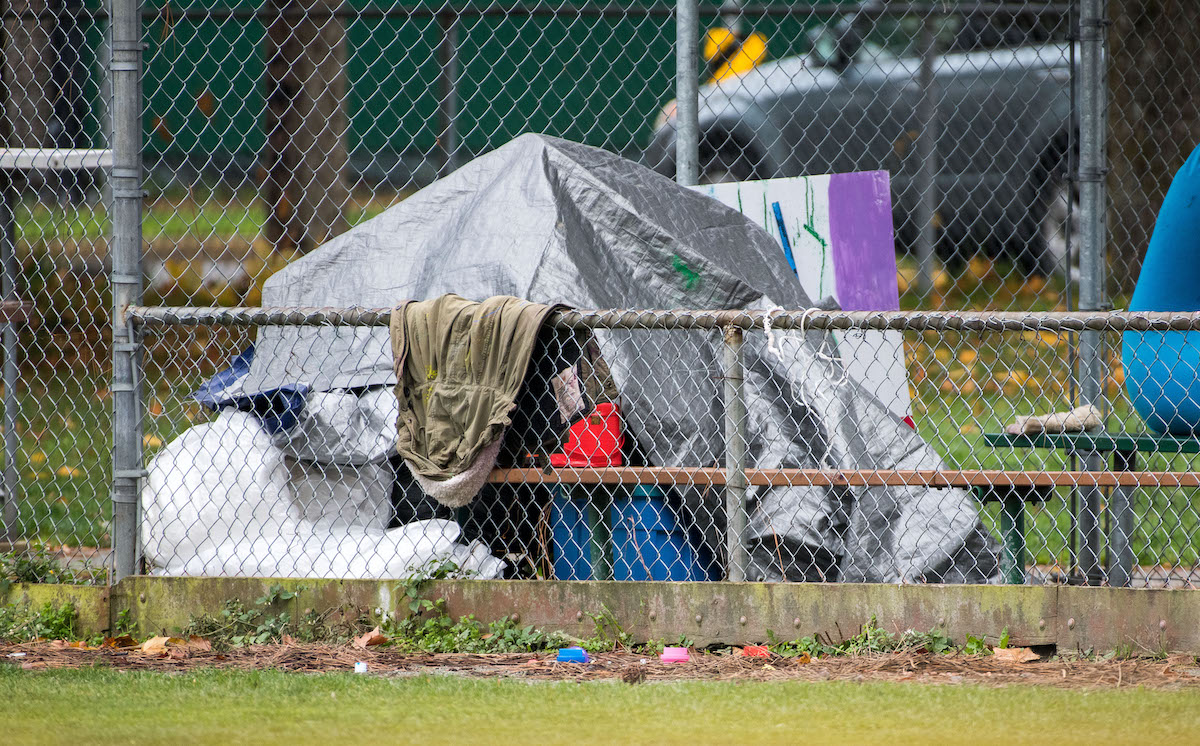
A tent erected in Central Park near Crystal Pool, 2021. Photo: James MacDonald / Capital Daily
Earlier this year, in a 24-hour period, a crew of 130 community volunteers set out to count the number of people experiencing homelessness in Victoria.
Yesterday, the results were released; on the night of March 25 and during the day on March 26, at least 1,749 people were without a home.
This is a slight increase from the last Point in Time (PiT) count in March 2023, when 1,665 were found homeless.
Not all of the 1,700+ spent the night in the same way; they slept in tents, shelters, or on a friend’s couch.
Where people spent the night:
- 318 were unsheltered
- 493 stayed in emergency shelters
- 73 were couch surfing
- 112 were using a public system
- 750 were in transitional housing
Data was collected from 58 locations, including shelters, transitional housing, and health facilities. Surveys were completed at 20 indoor sites and along 26 walking routes throughout Greater Victoria.
Stay connected to your city with the Capital Daily newsletter.
By filling out the form above, you agree to receive emails from Capital Daily. You can unsubscribe at any time.
The report’s authors write that their findings serve as a reference point for support-service providers and decisionmakers to respond accurately to the unique needs of the city’s homeless population.
“These findings offer a meaningful opportunity to explore the root causes of homelessness within our local context and to better understand how it can be prevented in the region,” the report reads.
Survey results: how homelessness occurs
In addition to counting people, volunteers also conducted surveys of 607 individuals, gathering insight into how and why people were without housing.
Apprehension about staying in shelters appears to have grown; 76% of respondents said they had a reason to avoid them, with the top reason being safety. This is a large increase from 2023, when 45% said they had a reason for avoiding shelters.
Nearly half of respondents had lived in Victoria for at least five years and nearly a quarter have lived here their whole lives. In the past year, 73% of respondents were homeless for nine to 12 months.
Of those surveyed, 68% were white, 30% were Indigenous, and 11% were other. Indigenous people were largely overrepresented in the count as they only make up 5% of the population.
More than two-thirds of respondents were men and the average age was 45.9 (39% were between the ages of 40-54). Those over the age of 55 made up 27% of the unhoused.
Almost all (92%) of respondents had at least one form of income. More than half said they rely on disability benefits for income.
More than one-third of respondents were in government care during their childhood and 33% of that one-third ended up homeless within the first year of leaving the foster care system.
Health concerns were a major issue for many of the respondents:
- 80% dealt with substance use issues (an increase of nearly 20% compared with PiT 2023)
- 67% experienced mental-health issues
- 53% had a physical disability
- 40% had a brain injury
- 18% had a developmental disability
- 12% were discharged from a hospital into homelessness
- 67% said they were in need of primary care services
When asked what barriers they faced in finding housing, the top two answers were high rent prices and low income; 60% of respondents said they were on the waitlist for subsidized or supportive housing.
“This count serves as both a snapshot in time and a reminder that behind each data point is a person, a story, and a fundamental right to safe, appropriate, and permanent housing,” the report’s authors wrote.
Stay connected to your city with the Capital Daily newsletter.
By filling out the form above, you agree to receive emails from Capital Daily. You can unsubscribe at any time.



.jpeg)