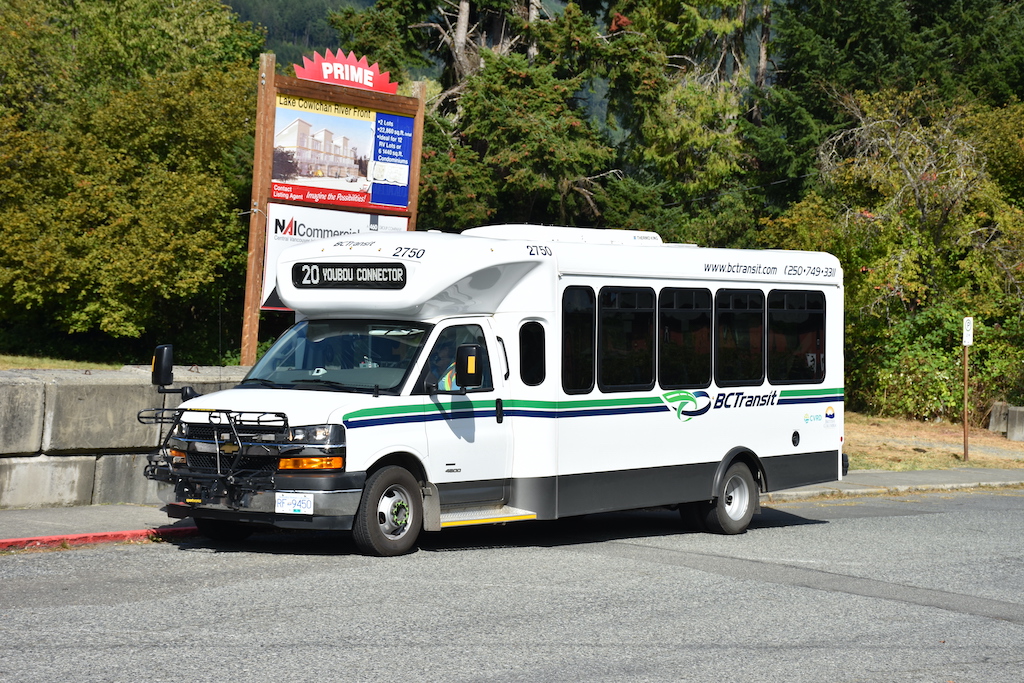
North Cowichan resident Carolyn Ronald says her life was upended when BC Transit bus drivers walked off the job nearly seven months ago.
Her husband has disabilities and relied on HandyDART—BC Transit’s accessible transportation service—to travel to day programs, she says, adding that Cowichan Valley’s other transportation service for disabled passengers is prohibitively expensive.
So Ronald started “playing taxi” for her husband. Ronald says she’s grateful to be physically and financially able to drive—but added that not everyone in the Cowichan Valley is as fortunate.
“It’s an injustice that so many people with disabilities have been left literally on the side of the road.”
The Cowichan Valley Regional Transit’s 44 bus drivers and eight HandyDART operators, represented by Unifor Locals 114 and 333 respectively, walked off the job seeking wage parity with Greater Victoria drivers and a guarantee that they’ll be able to use the washroom while on the job.
On Friday, Labour Minister Jennifer Whiteside appointed mediator Vince Ready to help the two sides come to a deal. The unions and Transdev, which operates the service under contract with BC Transit, have 10 days to reach a settlement before Ready recommends terms for a new contract.
“This dispute has gone on for far too long,” Whiteside said in a statement emailed to press. “There’s a real urgency for the parties to get back to the table, find a fair resolution and get transit services back on the road.”
It’s good news for Ronald, who has called for the provincial government to intervene. But she adds the dispute highlights the problem with privatizing a public transit system.
“Short term, we have to get the buses rolling again,” Ronald said. “But ultimately, we need one transit system for all of Vancouver Island.”
Washrooms and wages
Transdev Canada is jointly owned by Caisse des Dépôts, a French public financial institution and the Rethmann Group, a German family-owned holding company.
BC Transit contracts Transdev to operate regular and HandyDART services in the Cowichan Valley Regional Transit system, which serves about 95,000 people from Shawinigan Lake to Ladysmith.
Unifor Local 333 President Stephen Bains said both groups of bus drivers have been negotiating new collective agreements since January 2024. Their contracts expired March 31, 2024.
Bains said drivers were seeking wage parity with their counterparts in Victoria, the neighbouring transit area to the south. Currently HandyDART drivers in the region make $28 per hour while conventional bus drivers make $31.
That’s lower than in Victoria, Bains said, where drivers make closer to $38 per hour.
Bains said workers also wanted better access to washrooms. The Village Green Mall in Duncan, B.C., is a major hub for local routes, and for many drivers, the only opportunity to use a washroom.
The only washrooms available are at private businesses — a London Drugs and Save On-Foods in the plaza.
“In many cases, when the driver gets there, the washroom is already occupied, and in some cases, there’s a line of actual customers that are waiting,” Bains said. “For transit operators who are already under the pressure of a schedule, that does not work.”
He said bus drivers are often forced to skip washroom breaks to resume bus service on time, meaning they go up to three hours without a break.
Bains said drivers wanted language in their collective agreement that would guarantee a washroom for bus drivers at that stop, and enough time to use it.
‘One day longer, one day stronger’
Both groups of workers walked off the job Feb. 8 after voting down an offer from Transdev that Bains said didn’t address the washrooms issue or make significant gains on wages.
The strike cut services across the region and reduced HandyDART services to only offer trips to customers attending renal dialysis, cancer treatment and multiple sclerosis treatments.
In July, the provincial government appointed a mediator. But bus drivers again voted down the mediators’ proposed settlement.
“Our members firmly believe that their rights to washroom access and washroom breaks a principle that they will continue to stand on the picket line for,” Bains said.
Bains added the strike was starting to put strain on the bus drivers too. He said strike pay was about $300 per week. Some members have moved in together to cut costs, according to Bains, and many are facing financial hardship.
“It has been tough, but as they say, one day longer, one day stronger,” Bains said.
The strike has dragged on longer than the 138-day Sea-to-Sky bus strike in 2022, which at the time was reported to be the longest transit strike in provincial history.
North Cowichan Mayor Rob Douglas said in a July open letter the strike had gone past tolerable limits and was severely hurting the lives of others who rely on transit.
But many people who rely on the transit system say they support the striking bus drivers, like Ronald.
“I have every sympathy with the workers,” she said.
Ronald reached out to the Victoria Transit Riders Union, a grassroots organization of bus riders, to organize a rally in support of the striking workers.
“Everyone on the bus is going to be safer and happier if the bus driver, to put it bluntly, has a full belly and an empty bladder,” said Nathan Bird, a member of the group.
“These are people in our community, our neighbours, our community members or family members who are the transit workers.”
On Aug. 30, about 50 people — including Ronald — rallied in Duncan in support of the striking workers.
“I don’t think it’s the workers who are causing the service disruption,” Bird said. “It’s Transdev. Transdev is holding the Cowichan Valley transit riders hostage.”
Transdev Canada declined an interview. But spokesperson Frédéric Bourgeois-LeBlanc said in an email the company is deeply disappointed that the union rejected a tentative agreement, leaving Cowichan Valley without public transit.
“The Cowichan Valley continues to be deeply affected by this disruption to an essential service,” Emily Watson, the company’s senior vice-president for Western Canada, said in an email.
Watson added Transdev Canada is committed to reaching a fair resolution.
But Bains said the two sides’ failure to reach an agreement highlights how rural bus drivers aren’t valued as highly as bus drivers in more populated areas, like Victoria or Nanaimo.
“A lot of transit operators feel like ‘I’m doing the same work, and yet I’m being compensated remarkably differently’,” he said. “That inequity in this industry is something that all the members on the picket line are very passionate about.”
Bains told The Tyee on Sept. 3 he hoped they wouldn’t need government intervention, but a provincially-appointed special mediator could help the two sides reach a deal faster.
Mediator Ready is renowned for bringing difficult labour negotiations to an end, Whiteside said in her statement. He helped mediate the Fraser Valley transit strike in 2023.
“This appointment provides a path for the parties to work through their differences, and I appreciate their willingness to engage in this process,” she said.
After hearing the province appointed a mediator, Bains said in an email the union and its members were feeling optimistic.
“We are hopeful that Mr. Ready will bring the objectivity and clarity required to bring justice for a workforce looking to establish wage parity in an industry that lacks it and washroom access for workers that need it,” Bains said.



.jpeg)