At the mouth of the Jordan River in Pacheedaht First Nation territory, the tide is pushing.
Heat from a February sun warms the face as sets of friendly waves roll in under the backdrop of the Olympic Mountains. Parking at the day-use area of this regional park is squeezed on this fine Friday away from the screen.
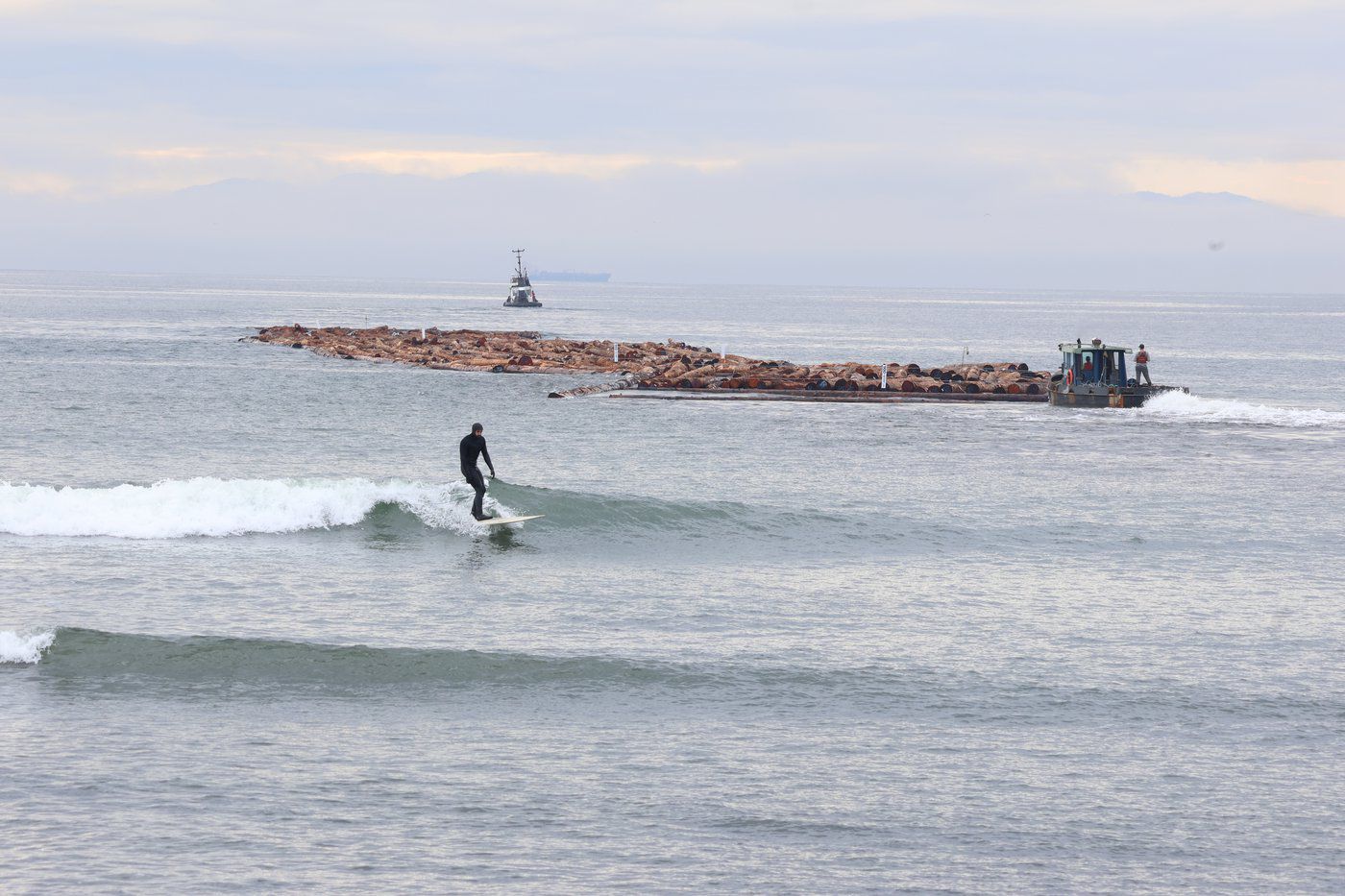
The tugboat Miss Jordan cruises by a bob of surfers, dragging a line of thick rope toward a raft of floating logs, known in these parts as a log boom. Some of the surfers catch a wave toward the cobble shoreline and then exit the water.
“They’ll run right over us if we don’t get out of the way,” says a stand-up paddler.
“But it is a nice day for it,” he concedes.
The discord between BC's forest industry and its tourism industry was ever apparent as surfers rode peeling waves while the Jordan River log boom got towed through the lineup before disappearing into the horizon.
Many people in British Columbia, including those living in remote First Nations communities, still rely on forestry revenue to keep the lights on. But as the forestry industry continues to wade through economic uncertainty, outdated forest legislation, and in some regions, a declining fibre supply, one can’t help but wonder: Could shifting gears to tourism be the smart move?
“I think about where are we going to be in 50 years or 100 years. I think about what this world is going to look like,” says Paula Amos, chief marketing and development officer for Indigenous Tourism BC (ITBC).
Amos is of Hesquiaht and Squamish Nation descent. Born and raised in Nuu-chah-nulth territory on the west coast of Vancouver Island, she currently resides in North Vancouver and has been working for ITBC for over two decades.
“We watched the fishing industry decline to a scary, scary point. And we depend on that food. We as Nuu-chah-nulth need that food sovereignty. Now we’re watching the forestry decline. We are in a place where we need to look at other options and have a new story. I think tourism is a great option for that story,” Amos says.
In the last five years, Amos says Indigenous tourism has seen significant growth. In the resort municipality of Tofino, Ahousaht Ha’wiih (hereditary chiefs) launched the ecotourism business Ahous Adventures in 2023 and, that same summer, Tla-o-qui-aht expanded their business portfolio with the opening of Tsawaak RV Resort and Campground adjacent to Tin Wis Resort.
Most recently, on the other side of Vancouver Island in Campbell River, Wei Wai Kum First Nation announced the acquisition of a majority interest in the Campbell River Adventure Tours Group, which includes Campbell River Whale Watching and Wildcoast Adventures.
“This acquisition marks the transition of one of the region's premier adventure providers into an Indigenous-owned business and is a major step in a broader economic sovereignty strategy,” the Wei Wai Kum First Nation said in a news release.
“It secures a robust revenue stream to support community programs, infrastructure, and social services. More importantly, by owning a leading marine ecotourism operator, the Nation reasserts its presence and guardianship over its traditional marine territory, ensuring operations align with Indigenous stewardship values,” they said.
With more than 400 Indigenous tourism-related businesses open in 2023 supporting 9,962 jobs, Amos says First Nations are just “scratching the surface” of an industry filled with opportunity.
“Indigenous tourism is more than just building economies and jobs,” she said. “It’s about Indigenous people using tourism as an avenue to educate the world [about] who we are as First Nations people, as Indigenous people. It’s a way for us to get out on the land in a new way. It’s connecting youth and elders and sharing the knowledge.”
The tourism industry contributed $9.7 billion to the provincial gross domestic product (GDP) in 2023, according to government statistics.
That's $4 billion more than forestry. Amos says shifting to tourism doesn’t necessarily mean shifting to serving patrons, with more people finding ways to enter the supply side of the industry.
Indigenous-owned Sea Wench Naturals supplies non-chemical hair and body products to resorts, short-term rentals and retail shops throughout BC. Originally founded by Sharon Whalen and Chris Taylor, the mother-and-daughter team Quoashinis (Cosy) and Laterra Lawson took over the Tofino-based business in January 2025.
“We’ve grown up with Sea Wench from the very beginning. It’s not new to us by any means. The ownership is new to us, but its products and its way of being are not new to us at all,” says Cosy.
The way Cosy sees it, the tourism industry has an economic “waterfall effect” on small businesses like Sea Wench.
“These businesses have the ability to uplift the community behind them,” she says. “We had a person that emailed us last week and they said, ‘Every time I hop in the shower and use your body wash, it makes me want to come back to Tofino.’”
Cosy and Laterra encourage others to find something they are passionate about and share it.
“No matter where you are, people will find you. Whether it be guiding or even just making food out of your house for hikers going by, if it’s consistent and it’s there, the story will travel and it will continue to grow. You have to have patience,” they say.
‘Tourism and forestry can work hand in hand’
The Jordan River log boom was destined for the Fraser River, where the privately owned Richmond Plywood will turn them into sheets of plywood to be sold to local lumberyards for building houses, says tree farm licence (TFL) 61 manager Angus Hope.
The harvest tenure for TFL 61 is held by Pacheedaht Andersen Timber Holdings (PATH). PATH purchased the relatively small 20,000-hectare Jordan River TFL tenure from Western Forest Products in 2010.
“We probably do a couple of tows a month. We are super-duper weather-dependent. It’s challenging because you’re dealing with tide and wind and swells,” said Hope.
He laughed when asked to talk about how the forestry operation is doing.
“That can be a very, very, very long answer,” he says. “There are a lot of challenges.”
From the “glacial pace” of government to the high cost of getting the logs to market, Hope says the status quo just doesn’t make sense anymore.
“A lot of the old tenures for tree farm licences have been around for a long, long time where it was big industry, feeding a mill or two. Now it’s getting a lot smaller, and First Nations are getting involved directly. We have to change,” he says.
He envisions a future where tourism, community and industry work together to manage a geographical area.
“Tourism by itself isn’t going to replace what forestry does for the economy. We can’t just be forestry, we need all sorts of stuff going on. There is no doubt in my mind we can make those things work together,” Hope says.
Recent provincial data show that in 2023, BC’s forest sector generated 50,225 jobs, $5.62 billion in GDP and reported $694 million in provincial government revenues.
While PATH does harvest some old growth, Hope says the majority of the trees they cut are second-growth timber, and they plant more than they harvest.
“This year it’s all second-growth. We’re looking over time to transition to where it’s going to be all second-growth. Again, part of the challenge there is with government policy; pricing and values as to how you can get to market faster. We have the volume to do it; it’s just a matter of getting costs and values in line,” he says.
“You get more volume out of a second-growth stand than an old-growth stand. Some of the oldest second-growth down there is 90 years old," Hope continues. We are truly sustainable, no doubt about it.”
Amos believes the old-growth forests are worth more standing, both economically and holistically for the ecosystem. Remaining old-growth stands such as Cathedral Grove near Port Alberni and along the Big Tree Trail on Meares Island, a short boat ride away from Tofino, draw hundreds of thousands of visitors every year.
“We look at it longer term rather than the shorter term of what that benefit is,” she says.
Access to the land
Hope shares that PATH is constantly maintaining the forestry road, fixing up trails for dirt bikers, or dredging rocks from the shore for the surfers. He says most of the work is “goodwill,” and it’s all just a cost to the business.
“Tourism and forestry can work hand in hand. It’s not one or the other. For where we are, one of the bigger things we provide is access to the land,” Hope says. “We share the area of the tree farm with many different users of the land and resources.”
North of the Jordan River, a series of privately owned gravel logging roads connect Pacheedaht First Nation to Ditidaht First Nation, which operates the Nitinaht Lake Campground and Windsurf Park, a third stop along the West Coast Trail.
A quick internet search reveals the campground is nearly sold out during the weekends of peak summer season, and with the opening of the new visitor centre and cabins last summer, Ditidaht appears to be well-positioned to welcome more visitors.
There are challenges.
Road access to Nitinaht is in dire need of safety upgrades. And while the province flags the roads as detour routes during emergencies like the 2023 Cameron Bluffs Wildfire, the transportation ministry says, "Long‑term decisions about upgrades or investments in private industrial roads remain the responsibility of the road owners and require collaboration with Indigenous and local partners.
“These roads are privately owned and operated, and the ministry does not plan to take over ownership or management. Any change in designation would require consultation with local communities and the Ditidaht First Nation,” the ministry said.
The infrastructure gap faced by Ditidaht is a key barrier to tourism growth for First Nations, on par with the shortage of staff and affordable housing in Tofino and the high operating costs of living in a remote community.
For Cosy and Laterra, their small business has dealt with “hiccups” like the Canada Post strike, road closures due to wildfires, and American tariffs. But for them, a successful business doesn’t necessarily mean raking in the cash.
“A business is something that supports you,” Cosy says.
“It keeps the funds in the community. It’s like the old fishing; we used to have a fishing boat in every family, and each family just caught enough fish to get themselves by. It wasn’t about making the most money; it was about enough, enoughness.”








.jpeg)