Death comes to Craigdarroch Castle
Another funerary ritual of the Victorian era involved something, or someone, called a sin-eater who would be called in to spiritually cleanse a dead person’s soul, even at times using the expired body as a table.
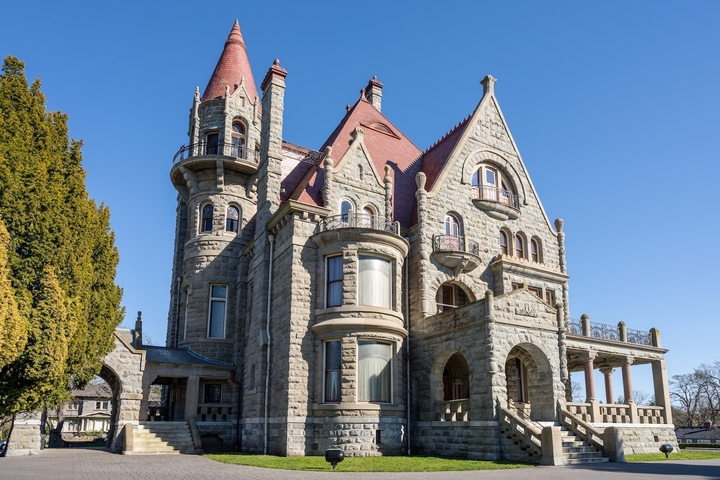
Craigdarroch Castle. Photo: Shutterstock
Coal baron Robert Dunsmuir died a year and a half before his wife Joan and their 10 children could move into the manor he commissioned, but it wouldn't be the last death to touch Craigdarroch Castle.
Joan would die there. And countless soldiers convalescing from the horrors of the First World War would call it their last home.
So the castle makes an appropriate setting for death this weekend when students from Camosun College’s anthropology program take over all four floors to explore cultural perspectives on death, mourning, and remembrance.
“We are going back in time, and we are inviting the public to come to the wake to see what that would be like,” says anthropology instructor Nicole Kilburn, who teaches the course Anthropology of Death.
Visitors to Craigdarroch Castle on Saturday afternoon will be met with the casket of John O’Neill, a fictional character of Irish descent who "died" in 1900. His body will be laid out in the library room, the same area it’s believed Joan’s wake took place following her death in 1908.
No word on whether O’Neill’s eyes will be covered by coins, as was the practice in the era, to keep the eyelids closed.
“People will have to come to the castle on Saturday to find out how John O’Neill is turned out,” Kilburn says.
Funeral rites and rituals will take place for O’Neill, allowing visitors to see how people in the Victorian era memorialized death, building on strong traditions shaped by the social mores and economic standards of the times.
These things take time
Back then, mourning was a prolonged practice. A woman who lost a husband could openly grieve for two years or more, with various stages of the mourning period displayed in what she wore. If a woman sported a dull, black veil, she likely was recently widowed.
“It wasn't just the color black,” Kilburn says. “The fabric actually wasn't allowed to be lustrous, like shiny. It was often supposed to be kind of scratchy. None of this is happy and comfortable—it was this physical manifestation of this sorrow.”
Anyone coming across the widow could determine the progression of her mourning through her attire—if she had no veil and was wearing a shinier shade of black or a mauve, she was further into the bereavement.
Death during the Victorian era was common—(big families, high child mortality rate)—public, and highly ritualized.
Families losing loved ones took a lot of time to get over it—Queen Victoria mourned Prince Albert for decades—and pulled out all the stops to try to help push their journeys from death to the afterlife.
Time can stop
Clocks were stopped at the time of death to prevent bad luck. Mirrors were covered to prevent the deceased’s spirit from being trapped behind the glass. A black wreath was often hung on the front door, and curtains were drawn to let neighbours know a death had occurred. People of means and in mourning often draped their furniture in black fabric.
Another funerary ritual of the Victorian era involved something, or someone, called a sin-eater who would be called in to spiritually cleanse a dead person’s soul, even at times using the expired body as a table.
A “sin-eater” would eat bread or a special cookie to absorb the sins of the dead. Depending on the social status of the deceased, the cookie could be spicy (meaning they had money) and was usually wrapped in keepsake paper adorned with a poem or hymn verse.
Habitually, the sin-eater was a poor person who could use the free lunch.
“You're unburdening somebody else's soul by eating their sins to fill your belly with calories to make it through another day in the mortal world,” Kilburn says.
“It's quite a trade-off, right?”
A wake could last a long time, partly to ensure the person was indeed dead, but also to allow time for family and friends to travel to the funeral.
Sometimes the body had to be shipped to the funeral.
Death wasn't local for everyone
Since most affluent residents of Victoria were Christian, it was a given that their bodies would be buried here. But sometimes, as was the case with many Chinese and Japanese who worked the Dunsmuir coal mines, there was a slight planning challenge.
“Their remains needed to be taken home, and if you can imagine what the logistics of that would have been like, without a phone, without email, without a fax, literally trying to transport remains a world away to make sure that their families could look after their ancestors,” Kilburn says.
On Saturday, students will be in the servants’ quarters to talk about how benevolent associations took on the responsibility of disinterring remains originally buried in Ross Bay Cemetery or Harling Point and shipping them home to be reburied in their homelands closer to their families.
Students will also be set up in Craigdarroch Castle’s kitchen to discuss how food played a role in funerals.
“It's often for the bereaved, but it can often also cross-culturally have really important roles for the deceased, either feeding the spirit or looking after the newly deceased person,” Kilburn says.
In the Victorian era, Kilburn says, there was a real interest in all things death and dying, including spiritualism.
“I think it was very much front and centre in people's lives, much more so than today. And so spiritualism offered, maybe, an opportunity to maintain some sort of a relationship with the deceased by using mediums and the context of a séance to be able to continue to ask questions and maintain relationships.”
Staying the course
Roughly three dozen students are currently taking the course, which has been offered since 2018.
“Courses and activities like this provide us an opportunity to think about death and talk about it in a safe way, but also to appreciate being alive,” Kilburn says.
“Death and grief can be very personal topics, and I’m clear about that from the very beginning with students. We are exploring it in a respectful and culturally sensitive way, but it can’t help but get personal.”
As for Saturday’s partnership with Craigdarroch Castle, John Hughes, the castle’s executive director, says it fits nicely with the Castle Society’s continuing efforts to connect with the community and its desire to offer new experiences at the museum.
“We’re excited for the students [to] shine a light on this topic, which is of great interest to many of our visitors.”
The event runs from 1pm to 3pm on Saturday, Nov. 29, at Craigdarroch Castle.
All activities are included in the price of a regular admission.