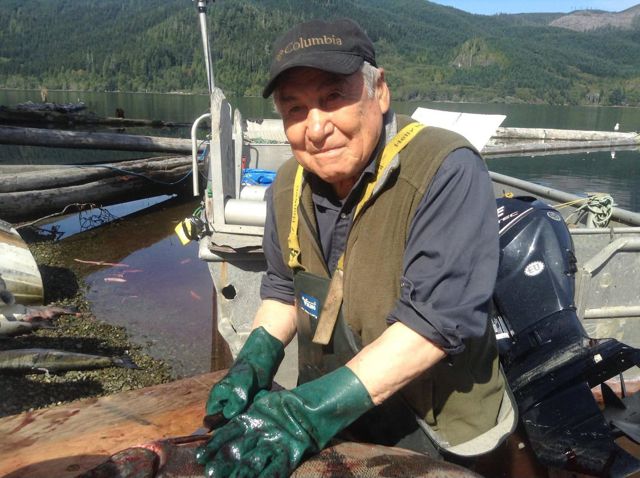
Like a giant cedar tree cut down, the passing of Ditidaht elder Michael Thompson (Kwiibaalaah) this summer left a mark on the Nuu-chah-nulth landscape, leaving the younger generation with less.
Thompson was the lone fluent speaker of the diitiidʔaaʔtx̣ (Ditidaht) dialect. He passed away on July 13, 2026, in Ditidaht’s main village of Balaats’adt on Nitinaht Lake, about 60 km west of Lake Cowichan.
He was 93.
“With the last speaker going, it means that our children and grandchildren won’t hear actual fluent speech,” said Bernice Touchie, an Aboriginal language specialist.
“Language changes all the time, but there will be drastic changes without hearing the original, everyday language; the pronunciation, the accent, the body language—all of that was part of communicating at one time. Now they won’t see the actual use of it,” she said.
Touchie is a residential school survivor, a Nuu-chah-nulth language speaker, and an elder-in-residence at the Qʷayac̓iikʔiis Headstart Childcare Centre in the Yuułuʔiłatḥ (Ucluelet First Nation) community of Hitacu.
The best morning read in Victoria, bar none.
Stay connected to your city with the Capital Daily newsletter.
By filling out the form above, you agree to receive emails from Capital Daily. You can unsubscribe at any time.
She studied linguistics at the University of Victoria and holds a PhD in curriculum development and instruction from the University of British Columbia.
Touchie’s parents, Bob Joseph and Edith Thomas, were both Ditidaht speakers. She married into Ucluelet First Nation, a nation that speaks Barkley Sound, or West Coast, Nuu-chah-nulth language, one of three closely related languages: Ditidaht, West Coast and Makah.
Touchie explained that those three languages form a subgroup of the Wakashan Language Family.
The Ditidaht dialect is more connected to the Makah Tribe in Neah Bay, Washington, U.S.A., which is why the language in the nation south of the border is closer to the Ditidaht dialect, says Touchie.
Conversely, Touchie says Ditidaht dialect switches Ds where they have Ns and Bs and Ms.
The Pacheedaht First Nation people in the town of Port Renfrew on south Vancouver Island also speak a dialect closely related to the Ditidaht language, Touchie said.
The Wakashan language family is one of three—along with Tsimshian and Salish—that is predominantly found in British Columbia, according to Statistics Canada.
“Teaching (our) language now is even more difficult now than teaching a second language because the government ignored our language with the school systems. There is no curriculum and very little written about Ditidaht,” said Touchie.
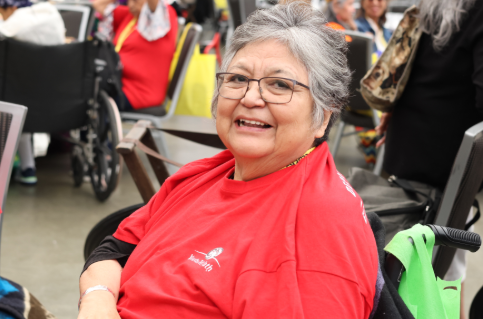
Bernice Touchie is an elder-in-residence at the Qʷayac̓iikʔiis Headstart Childcare Centre in the Yuułuʔiłatḥ (Ucluelet First Nation) community of Hitacu. Nora O’Malley photo
Thompson was a survivor of the Alberni Indian Residential School. His brother Charlie shared that he was punished for not knowing how to speak English.
“He was slapped for speaking his language,” said Charlie.
Despite this affliction, reads Thompson’s obituary, he made a conscious and thoughtful effort to live his life with a sense of devotion and worship to the word of God and the sacraments of the Indian Shaker Church.
Teachings preserved online
Charlie says his brother taught language at the Ditidaht clinic and at the community school. He says some of Michael Thompson’s teachings are preserved on FirstVoices.com, the Indigenous language revitalization platform, and at the school.
“We are all shocked by his passing. He was the oldest elder. Nobody else can say they are fluent in our language,” said Charlie.
Todd Flaro, 59, from the Kuu-uus Crisis Line West Coast We Care Team, also captured about three hours of footage of Thompson sharing stories.
“It’s just something I wanted to do. The next generation is losing out. I have pictures of my grandparents, but I can’t remember how my grandmother talks anymore,” said Flaro.
“We are already out in the community at least once or twice a month, so I am just trying to snag some time with them. The goal is to build a catalogue of different topics with each person but also have edited videos of just that person and then put it online,” he continued.
Flaro says it took a couple of years before Thompson would even talk to him.
“I have to build bonds because of the way I look, and Michael was a bit of a hard nut to crack,” Flaro said.
"Ninety-three years old, he could tell you months and years, like back to the ‘40s and ‘50s. In 1956, he moved from the ocean portion of Ditidaht to where the village is now. He talked about fishing in a dugout canoe. He had a lot of faith, so he talked a lot about God,” said Flaro.
“There were a couple of times I had to walk away,” said Flaro, choking back tears. “He got into residential school once or twice… Michael refused to be defeated and give up his language, and he paid the price for that.”
Flaro shared that he will release the recordings to Thompson’s family if they do a Drying of the Tears ceremony next year. He says he did get some footage of Thompson speaking fluent Ditidaht.
Language keepers are left to do research
For Touchie, Thompson’s passing is “scary” because now the language keepers are left to do their own research to construct the language.
“Sometimes it’s just a phone call away to ensure what is correct,” said Touchie.
She says when it comes toteaching childrenn the Nuu-chah-nulth language, the first thing to do is build friendship and trust.
“You have to relate theculturee to theirgreat-grandparentss and say, ‘this belongsto yourogreat-grandma and grandpa; they talked like this.’ Otherwise, it’s strange. They haven’t heard it before,” said Touchie.
The Nuu-chah-nulth Tribals Council serves about 10,000 members across 14 nations.
According to the 2021 census, the number of people who reported Nuu-chah-nulth as their mother tongue—that is, the language first learned as a child and still understood—was 325.